The Racial Glass Ceiling: Subordination in American Law and Culture by Roy L. Brooks
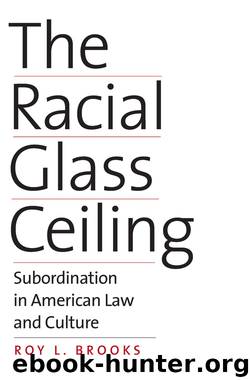
Author:Roy L. Brooks [Brooks, Roy L.]
Language: eng
Format: epub
ISBN: 9780300223309
Google: 2zLLDgAAQBAJ
Amazon: 0300223307
Publisher: Yale University Press
Published: 2017-01-15T00:40:04.685000+00:00
Resolving Cultural Subordination
Notwithstanding our professed commitment to cultural diversity, cultural subordination is a major factor in our mainstream culture. It is manifested in two distinctly different ways of defining the “melting pot,” that quintessentially American cultural ideal. Cultural assimilation, envisioned by the traditionalist norm that race no longer matters, and transculturalism, inspired by the critical race theorist core belief in social transformation, suppress contraposed values that spring from a black racial sensibility. The candidates for suppression include the belief that black is beautiful, that counteracting racism is a matter of some urgency, and that rooting out anti-black racism should be a high priority of the federal and state governments. Transculturalism’s progressiveness tends to distract one from racial subordination inherent in its requirement that each group thrown into the cultural mix must surrender some of its identity and, thereby, sublimate its special concerns to the concerns of the new progressive culture. Hence, the issue of anti-black racism might be given less urgency than, say, women’s rights, gay marriage, Syrian refugees, or immigration policy in general. How a culture prioritizes its limited resources of time, money, and moral outrage is a critically important determination.
That determination is at the heart of cultural assimilation and transculturalism. Both have legitimate social goals—social cohesion and progressive inclusiveness, respectively—that reflect legitimate post–civil rights norms: the convictions that race neutrality gives blacks the best chance for achieving racial equality (traditionalism), and that changing the relationship between race and power in our culture is an essential condition for racial equality (critical race theory). Assimilationists, in other words, argue that because government-sanctioned racism is no longer a factor in the African American’s chances for racial equality, there is no need to revisit the culturally divisive matter of race. We should, instead, focus on matters that ought to unite us culturally. Those things necessarily coalesce around the majoritarian middle—white middle-class values—to which all groups must adapt. Transculturalists, in contrast, begin with the conviction that the social order is constructed in the image of straight white men. That gives these insiders a cultural advantage, which needs to be addressed rather than ignored. Blending all cultural traditions is the best way to dilute that power. Although not necessarily racist, both positions hurt blacks by falsely assuming that blacks and whites (traditionalists) or blacks and outsiders (critical race theory) are similarly situated when in fact they are not at equal risk, as I explained more fully earlier in this chapter and in the introduction.
Biculturalism, in my view, is worse. It is not only tainted by the fact that it replicates cultural assimilation (hard biculturalism) or transculturalism (soft biculturalism) in the mainstream, but also by the fact that it gives cultural clearance to racism in the private domain. It is one thing to force people to act in a certain way in their private spaces, which I am not advocating here, but quite another thing to teach certain rules of propriety by which decent people should behave in private, which I am most certainly advocating here.
Download
This site does not store any files on its server. We only index and link to content provided by other sites. Please contact the content providers to delete copyright contents if any and email us, we'll remove relevant links or contents immediately.
| General | Discrimination & Racism |
Nudge - Improving Decisions about Health, Wealth, and Happiness by Thaler Sunstein(7758)
The Fire Next Time by James Baldwin(5503)
iGen by Jean M. Twenge(5454)
Adulting by Kelly Williams Brown(4622)
The Sports Rules Book by Human Kinetics(4448)
The Hacking of the American Mind by Robert H. Lustig(4425)
The Ethical Slut by Janet W. Hardy(4308)
Captivate by Vanessa Van Edwards(3864)
Mummy Knew by Lisa James(3729)
In a Sunburned Country by Bill Bryson(3583)
The Worm at the Core by Sheldon Solomon(3512)
Ants Among Elephants by Sujatha Gidla(3494)
The 48 laws of power by Robert Greene & Joost Elffers(3381)
Get What's Yours for Medicare: Maximize Your Coverage, Minimize Your Costs by Philip Moeller(3099)
Suicide: A Study in Sociology by Emile Durkheim(3045)
The Slow Fix: Solve Problems, Work Smarter, and Live Better In a World Addicted to Speed by Carl Honore(3040)
The Tipping Point by Malcolm Gladwell(2963)
Humans of New York by Brandon Stanton(2909)
Handbook of Forensic Sociology and Psychology by Stephen J. Morewitz & Mark L. Goldstein(2739)
